


“It is not our part to master all the tides of the world, but to do what is in us for the succour of those years wherein we are set, uprooting the evil in the fields that we know, so that those who live after may have clean earth to till.” - Gandalf
I’ve been away from Substack for a while. A lot of upheaval in my life left me with a lot to ponder - a lot to reconsider, even.
As readers of this Substack will know, I have written on various and sundry subjects. One of the more consistent thematic domains has been the intersection of faith, culture, and technology. One of my earliest Substack posts was A Right to Our Own Minds, in which I unburdened myself of some thoughts on the degree to which our attention is being actively manipulated and, as a result, many are being deprived of their own thoughts. I wrote in that piece of how technological complexity is overwhelming people’s sense of their fundamental competence and life-skills. I’ve written a number of pieces on AI. Some of the pieces have dealt with how it works; others were about what it means. I have complained about the slovenliness of the language used, even by writers I admire, when talking about AI. Not least because, as Orwell pointed out, slovenly language makes it easier for us to have foolish thoughts.
I have undertaken to express some thoughts about the unhealthy modern tendency to look to science for moral instruction. I have even tried to articulate an explicit framework for assessing the morality of any particular applied technology.
Does it discourage self-absorption?
Does it amplify human freedom?
Is it restorative of human purpose?
There are numerous writers, many of whom I otherwise like very much, who are undiscriminating in the way they write and speak about technology. In some circles, it seems de rigueur to decry “the machine”, even while in those very same circles, writers assiduously cultivate a following using the very “machine” they would have their readers revile. I am in no way blind to the benefits of doom mongering and hysteria as vehicles for stoking emotion and engagement. Whether such practices also stoke discernment is far less certain.
No honest reader of my Substack will come away believing that I am an inveterate booster of technology. But neither do I believe technology is inescapably sinister. “From the same mouth come blessing and cursing,” a wise man once said. Much depends upon the human choices we make in the way technology is applied.
I have decided to put my actions where my mouth (my keyboard?) has been, so to speak. Instead of confining myself to bloviating about these subjects, I’m moving toward applying some of the principles I have been writing about. In one sense, I’m making an effort to turn attention-manipulating technology against itself - to counter-program the efforts of those companies that my son refers to as “the attention pirates”. Together we’re building something that we hope might help thoughtful Christians be able to better align their digital lives and attentions with the virtues to which they aspire.
Welcome to holystic.ai
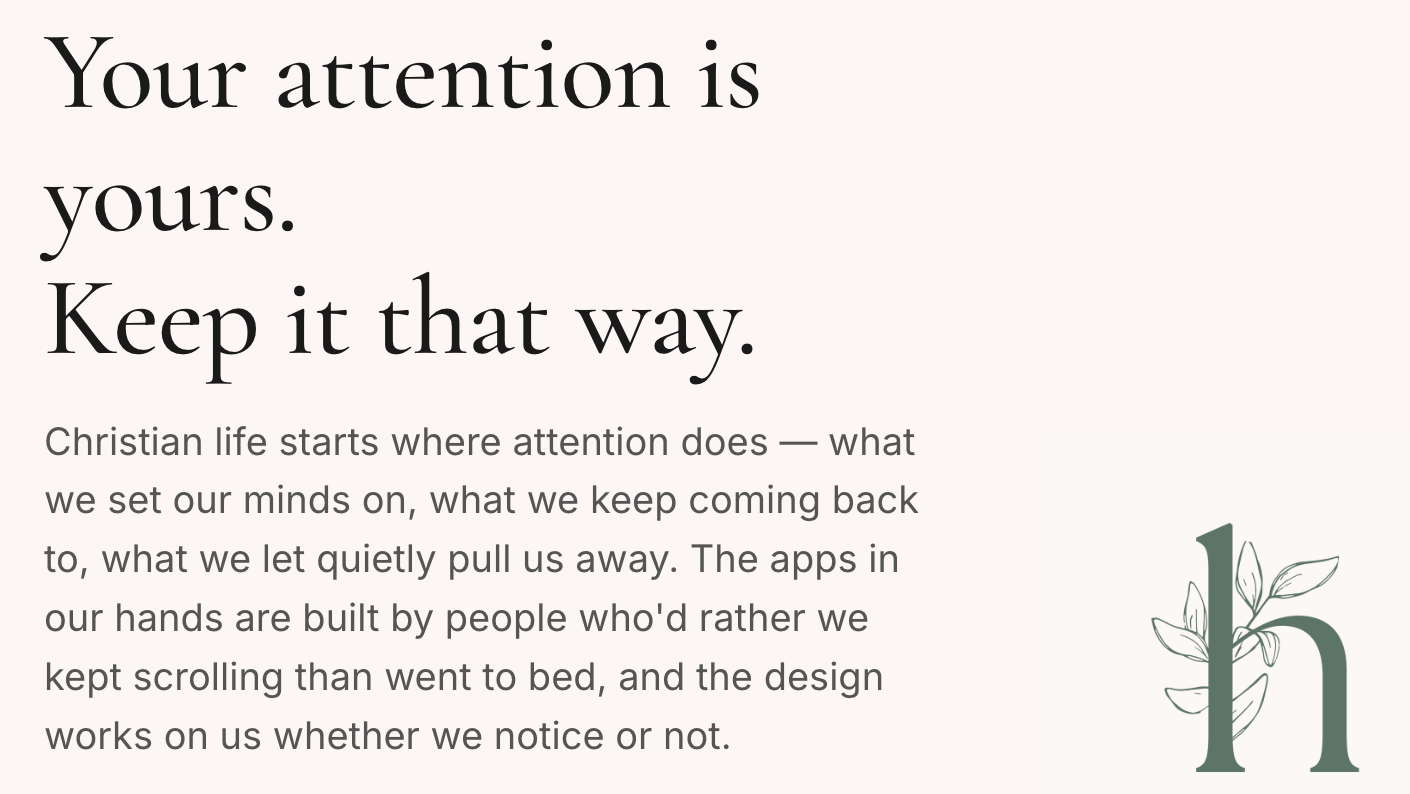
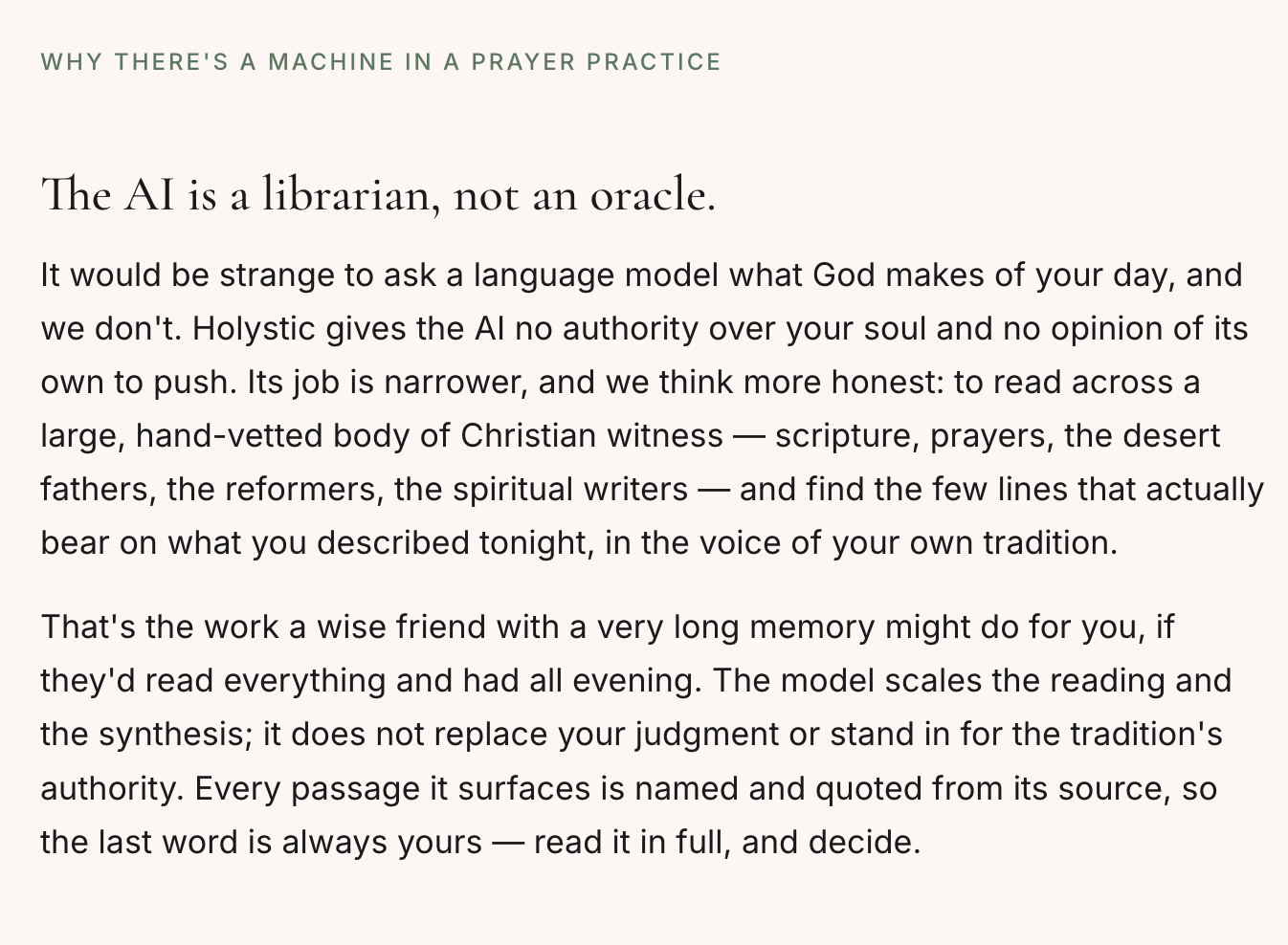
We’re using AI, but we’re not personifying it and we’re not granting it the status of an authority. We’re having it schlep through thousands of ancient Christian writings to pull out the pieces that are semantically relevant to how you yourself describe your life online each day.
The Holystic app can, if you give it permission (that’s up to you), compare the way you’re actually using your phone against your stated goals. It can nudge and remind you when the few minutes you wanted to limit yourself to on Youtube have bloated up into an hour.
It’s a dicey thing that we’re trying to do, actually. On the one hand, we want to help pry our users’ attention away from things that, by their own admission, they feel trapped by. On the other hand, we don’t want users merely to transfer their attention to Holystic instead. We’ll see how well we do at this delicate balancing act. Right now, at least, we’re leaning in to this idea: a daily practice in reflection, informed by ancient words of wisdom, combined with an app that can help you refrain from kidding yourself, might be able to help people more consistently set their phones aside.
We don’t block or scold. We don’t gamify the problem. We don’t anthropomorphize the AI. We nudge. We cajole. We encourage and remind. And, if you want us to, we hold your stated goals up against where you measurably spend your attention online, and then reflect all of that back to you for consideration.
There was another wise man who once observed that “there is nothing new under the sun”. That’s why we believe the ancient Christian writers may have something uniquely meaningful to offer to our digital moment; something that just might pique the interest of people struggling to align their digital engagement with the person they want to be.
Stay tuned.
Hustle up Keith! I need stuff to scroll through tonite. lol This sounds like a great idea... words of wisdom from the ages.
Neat! This seems to be the kind of thing Leah Sargeant has in mind:
https://www.otherfeminisms.com/p/friction-in-the-right-places